
Moving to a new province should feel pretty simple. It’s the same country, same currency, and mostly the same language. So why does it end up being one of the most confusing moves people ever make?
Here are a few things nobody tells you. Crossing a provincial line is quite expensive and resets almost everything administrative in your life. Your driver’s license, your health coverage, your car insurance, and even your taxes. They all work on a “new province, new rules” system.
- While most guides only give you a packing checklist, this one focuses on deadlines, coverage gaps, and the cost of a long-distance move.
Already know you’re moving? Get free quotes from long-distance movers on your route.
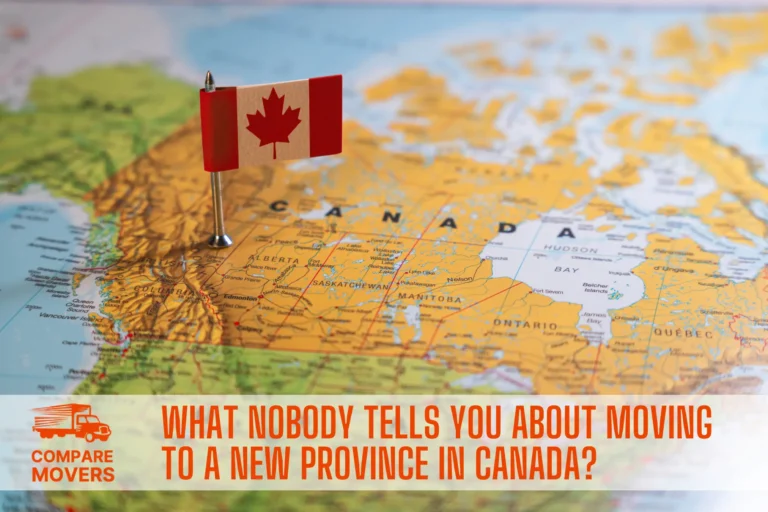
Things nobody tells you about moving to a new province
The stuff that catches people off guard is mostly related to deadlines. But it’s not just paperwork, as the move itself has its own surprises too:
- Your delivery date could be a window instead of a fixed day.
- You could share the truck with other clients moving to a closeby location.
- Not all movers offer the same services at the same price.
- You don't automatically keep your license.
- Your health coverage has a gap in nearly every province.
- Car insurance isn't one system in Canada, it's several.
- Your registration deadlines don't line up with your license deadline.
The moving to a new province checklist nobody hands you
Every moving checklist online tells you what to pack. Almost none of them tell you what happens after you unpack. Regardless of how unsettled you might still feel, the paperwork won’t wait. Here’s a glimpse of what to expect:
Steps to take before moving to a new province
- Book your movers early, ideally 12 weeks in advance.
- Cancel or transfer utilities with a forward date.
- Request medical and dental records from current providers.
- Stock up on a few months of any prescription medication, since finding a new doctor can take a while
Steps to take when moving to a new province
This is the gap period people forget about. For a few days or weeks, you might be in transit with no fixed address. Keep a copy of your lease or closing documents. You’ll need proof of your new address almost immediately after arrival.
Steps to take after you arrive in your new province
The day you arrive, the clock starts ticking. Here’s an overview of what you’ll have to handle not long after moving to a new province:
| Task | Average deadline |
|---|---|
| Health card registration | Register on day 1 (3-month wait for coverage in ON/BC/QC) |
| Driver's license exchange | 60 to 90 days |
| Vehicle registration | 30 to 90 days |
| Address update with CRA | Before your next tax filing |

What happens to your driver's license and health card when you move to a new province?
You don’t retake your driving test, and your health coverage doesn’t disappear, but both come with deadlines and waiting periods to respect.
How long do you have to switch your driver's license?
Depending on the province you’re moving to, you have anywhere from 60 to 90 days.
| Province | Grace period |
|---|---|
| Ontario | 60 days (ontario.ca) |
| British Columbia | 90 days (icbc.com) |
| Alberta | 90 days (alberta.ca) |
| Quebec | 90 days (saaq.gouv.qc.ca) |
What nobody mentions: Your old driver's license doesn't quietly expire in the background. In most provinces, it becomes invalid for driving as soon as the grace period ends, even if your new license hasn't arrived in the mail yet.
A common mistake: Vehicle registration deadlines are often shorter than driver's license exchange deadlines. In British Columbia and Ontario, you generally have up to 90 days to exchange your license, but only 30 days to register your vehicle and obtain new licence plates.
How long does the health care waiting period last?
In most provinces, the health care waiting period, which is a mandatory gap set by a new provincial government before your local public health insurance coverage starts, goes up to 3 months.
Before your new provincial health card becomes active, this waiting period is the norm across Canada. It applies for anyone moving from another province, not just an Ontario/BC/Quebec thing. It’s confirmed on the Nova Scotia government’s own page and Manitoba’s official health page, and it applies the same way in Alberta, Saskatchewan, and New Brunswick.
During the gap, you’re only covered for emergencies, and only through reciprocal billing agreements between provinces.
How to change your province of residence for your license, health card, and address?
As soon as you arrive, register in person or online, depending on the province, and bring proof of your new address, ID, and your old license or health card to surrender.
Every province has its own licensing body: ServiceOntario, ICBC in BC, Service Alberta, SAAQ in Quebec, and each requires slightly different documents.
The most common are:
- Proof of identity
- Proof of your new address (a lease or utility bill usually works)
- Your existing license or health card
You’ll also want to update your address with the CRA and your bank around the same time, since none of these update automatically.
Car insurance guide for moving to a new province
Your policy doesn’t follow you across Canada. Car insurance is provincially regulated, as rates, minimum coverage, and even the entire insurance model change once you move.
- Fully public insurance provinces:British Columbia (ICBC), Manitoba (MPI), and Saskatchewan (SGI) administer the mandatory basic auto insurance program, although optional coverage varies by province.
- Private insurance provinces: Ontario, Alberta, Nova Scotia, New Brunswick, Prince Edward Island, and Newfoundland and Labrador rely on private insurers for all mandatory auto insurance.
- Quebec's hybrid system: The SAAQ publicly covers bodily injuries under a no-fault system, regardless of who caused the accident. Drivers must still purchase private insurance for vehicle damage, theft, vandalism, and civil liability (including property damage and liability outside Quebec).
What to do about it?
- 1. Start shopping for new coverage before the move, not after.
- 2. Call your current insurer to confirm exactly when your policy stops covering you outside your old province.
- 3. Line up new coverage before your old policy lapses because driving uninsured without realizing it is risky and more common than people think.
What will your interprovincial move cost? Free estimator
The cost of your interprovincial move depends on your route, home size, and how flexible your moving date is. Even if this isn’t as accurate as our quote comparison services, this estimate will give you a price range in seconds.
Use this tool as a starting point to your moving process.
Free Estimator
What will your interprovincial move actually cost?
Estimated cost range
$3,200 – $5,100
Based on typical distance and weight pricing for this route and home size. Your real quote depends on your exact inventory — that's why comparing quotes matters.
No cost. No obligation. Takes about 2 minutes.
The hidden costs nobody warns you about moving to a new province
This is the part that turns a $3,000 move into a $5,000 one. Why is that?
- Fuel surcharges
- Accessorial fees (stairs, long carry distances, packing materials)
- Pack-and-label services
- Basic liability coverage is much weaker than people assume
- If your new place isn't ready, storage adds up fast
- Specialty items and access issues
- Shipping a vehicle
The pattern to watch for: none of these costs should be hidden from you. Ask for an all-in itemized quote up front, not just a base rate, so you’re not surprised by fuel surcharges, packing, storage, or specialty-item fees.

Tips for moving across the country
The best way to keep a long-distance move on budget is to get your quote after a walk-through of your home or a video survey, ask each company to quote the same scope, confirm whether the quote is binding or non-binding, review the insurance coverage, and ask if the long-haul portion is subcontracted.
One red flag worth remembering: If one quote is dramatically lower than the others for the same inventory and distance, it's probably not a deal. It often means the company may charge you more later or provide fewer services than expected.
Moving to a new province? Get free quotes from long-distance movers today!
Skip calling movers one by one and get to work by using our quote comparison services. It’s free, there’s no obligation to move ahead. But if you do, you’ll walk away with the best moving company out there.
- Submit one quick form and get matched with licensed long-distance movers available for your specific route.
Start budgeting for your interprovincial move now.

FAQs about moving to a new province in Canada
1
How much does it cost to move to another province in Canada?
It depends heavily on your route and home size. Short routes like Toronto to Montreal can start around $1,500, while long routes like Toronto to Vancouver for a full house can run well past $13,000.
2
Do movers charge more for long-distance interprovincial moves?
Yes. Movers charge more for long-distance interprovincial moves because pricing is usually based on the weight of your belongings and the distance travelled.
3
What should I do first when moving to a new province?
Start with housing and moving logistics, then focus on essential legal updates like your driver's license, vehicle registration, health card, and address changes.
4
Do I need to change my driver's license when moving to another province?
Yes. Every province requires new residents to exchange their driver's license within a specific deadline after establishing residency.
5
How long do I have to change my car insurance after moving?
It varies by insurer, so confirm directly with your current company. Insurance systems differ between provinces, and arranging new coverage before you arrive can help avoid delays.
6
Is my health card valid in another province?
Only temporarily through reciprocal billing agreements. For non-emergency care, you’ll need to register for your new province’s health insurance plan.
7
Can I keep my old province's health coverage during the transition?
No. Your old province's coverage generally ends once you establish residency elsewhere, even if your new province has a waiting period before coverage begins.
8
What documents do I need to update after moving?
You’ll need to update your driver's license, vehicle registration, health card, address with the CRA, bank information, subscriptions, and insurance policies linked to your old address.
9
How long does it take to become a resident of a new province?
There is no single official test or waiting period. In Canada, residency is generally based on where you live, work, and intend to stay. For tax purposes, the CRA considers your residential situation as of December 31 of the year.
Disclaimer: The information in this article is provided for general informational purposes only and does not constitute legal, financial, or professional advice. Provincial rules, deadlines, and requirements, including driver's license exchange periods, health coverage waiting periods, insurance regulations, and tax residency criteria, may change and vary depending on your individual situation.
While we've made every effort to verify this information using official government sources at the time of publication, we recommend confirming your specific situation directly with the relevant provincial authorities before making any decisions related to your move.
Moving costs and timelines are estimates based on typical market data and may vary depending on the mover, season, distance, and shipment details. We are not responsible for any consequences resulting from reliance on this content.