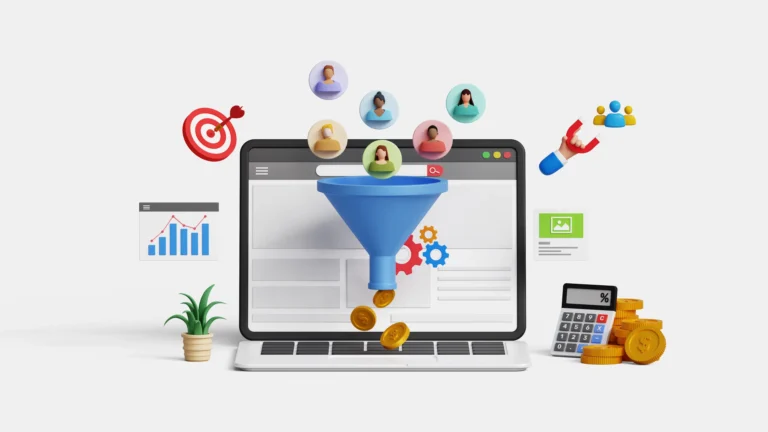

How you market your company and the strategies you put into practice are what make the difference between fully booked movers and those with open calendars.
- If you’re looking for the best ways to grow your moving company, this guide tells you what works in 2026, from local SEO to referral programs, so you can build a strategy that brings in bookings, not just clicks.
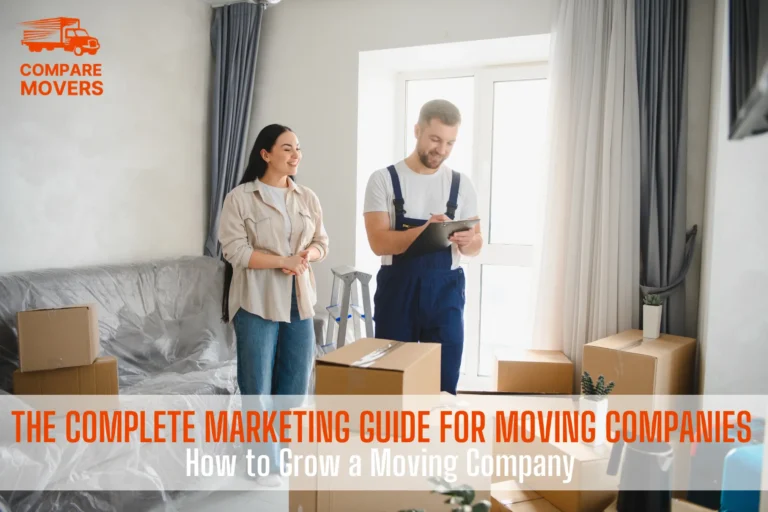
How to grow a moving company in 2026?
The easiest ways to grow a moving company right now are to focus on a strong local search presence, respond to leads quickly, and secure a steady stream of reviews.
The truth is that a large amount of research happens before someone books a mover, which means you could be losing potential customers if you can’t be found online as easily as your competitors.
In 2026, growth boils down to a few important levers that should all be pulled in tandem:
- A Google Business Profile and website that show up in local searches when prospective customers are looking for "moving companies near me"
- A constant influx of fresh and positive reviews
- Paid ads targeting the right audiences at the right time in their decision-making journey
- Content that answers the questions that customers are asking
- A follow-up process that is quick enough to jump in front of the competitors
- Referral and repeat business strategies that generate new bookings from past customers
The remainder of this guide will discuss each of these areas in more detail. But before we do so, below is a helpful table showcasing the marketing strategies.
| Marketing strategies | Cost | Time to see results | Effort to maintain |
|---|---|---|---|
| Local SEO | Low ongoing cost | 3 to 6 months | Medium, content, listings and reviews |
| Google Ads / PPC | Pay per click, scales with budget | Immediate | Medium, requires ongoing optimization |
| Content marketing and blog | Low cost, mostly time | 3 to 9 months | Medium to high, regular publishing |
| Social media and video | Low to moderate | Weeks to months | High, needs consistent posting |
| Direct mail and local outreach | Moderate, per piece or campaign | Weeks | Low to medium |
| Referral program | Low, incentive cost only | Ongoing | Low |
| Lead generation platforms | Pay per lead | Immediate and ongoing | Low |

Why does marketing matter more than ever for moving companies?
Local moving markets are highly competitive and saturated with companies constantly entering the fray and undercutting their competition.
If your goal is to be consistently booked, marketing is essential. Applying sound business and marketing practices is what makes your company visible to potential customers. It is truly the most important tool in a moving business owner’s toolbox. Here is why.
The moving industry is more competitive than it looks
The moving industry itself is extremely competitive. Local economies only have so many moving jobs, and new companies are eager to take advantage of the available work. Unless you are actively marketing your business, it is entirely likely that a bigger competitor will find their next customer before you can.
The way customers choose a mover today has changed
A customer that needs to move is unlikely to call the first number they find. They are going to shop around, looking at a few websites and reviewing their options before contacting a company, if they contact one at all. How quickly you respond to their request and whether or not they find your website easy to navigate and trust are more important than a slightly lower price.
Build a foundation before you spend a single dollar on ads
There is no point in spending money on ads if you don’t have a website, Google Business Profile, and reviews set up to convert.
Otherwise, you are paying for ads to drive traffic to your site, which will not be able to provide you with enough conversions or book enough jobs. Once you set up these resources correctly, you can scale by investing in other marketing tools.
A website that converts
Your website’s only job is to turn visitors into customers. That means a mobile-friendly layout, a quote easy to fill out on a phone, and clear calls to action on every page.
In addition, the form should be short and contain only the following fields: name, email, phone, move date, origin, and destination. As a rule of thumb, the shorter the form is, the more likely a customer will be to fill it out.
Here are a few elements that all websites should have to convert well:
- Clean design
- Load quickly
- Quote form on every page with no more than five fields
- Call to action on every page
- Recent reviews or testimonials near the form
- Licensing, insurance, or certification easily accessible
- Photos of your crew and trucks instead of stock photos
Optimize your Google Business Profile
A fully optimized Google Business Profile is one of the best things a business can do for free. You should include photos, service areas, current hours, and respond to every review directly, good or bad.
The Google Business Profile is often the first thing a customer will see, so it is essential to make sure it looks professional and useful.
Online reviews are your strongest marketing asset
Reviews do more to convince a hesitant customer than any ad. As such, it is essential to ask your customers for reviews after the move is completed and when their experience is still fresh in their minds.
Doing so via text with a direct link is an easy and effective way to ensure that your customers will leave you a review.

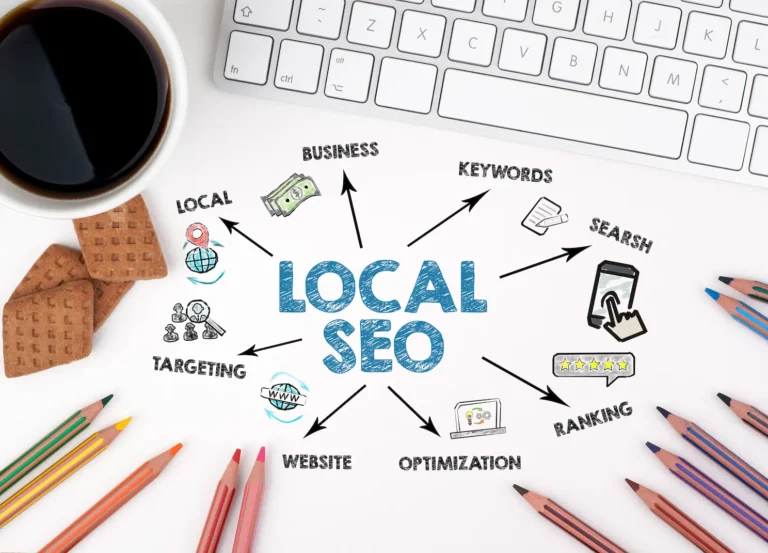
Local SEO for moving companies
Local SEO makes a business discoverable to customers who are actively searching for a specific service in a particular area.
It involves maintaining proper business information across all platforms, developing localized content, and generating enough authority for Google to reliably show your offering to local searchers.
Rank for "movers near me" and city-specific searches
By making sure a business appears in local queries, companies can drive traffic from those actively seeking out a moving service in their area.
This begins with making sure all elements of a business's online presence, from website content and directory listings to its Google Business Profile, are optimized and consistent with one another.
Build location pages if you serve multiple areas
For companies that operate in multiple regions, create a dedicated page for every major city you serve. This strategy tends to be more effective than only having a page about "our service area".
Get listed in local directories and moving-specific platforms
Beyond Google, many local platforms that specialize in moving services help to increase the visibility of your business's SEO efforts. Listings on these sites also tell Google that your business is legitimate and worth appearing in local searches. And as a moving company, you need to show up where local customers are searching for movers.
Paid advertising: Google Ads and PPC for movers
Although paid advertising generates leads quickly, it only brings new clients once your website and follow-up process are ready to convert that new traffic.
Because not all leads equal booked jobs, it is necessary to track the conversions to determine which ads influence users’ decisions and lead to conversion.
When PPC makes sense vs. when it wastes budget
PPC (pay-per-click) advertising is a great way to begin generating leads immediately while waiting for the website’s organic traffic to grow. However, it only makes sense when your website and landing page are solid enough to convert the traffic you're paying for.
Running ads when the website is slow and generic is a great way to waste a marketing budget.
Build landing pages for specific services
For example, an individual searching for a local mover or a company providing long-distance relocation services is more likely to convert if they land on a page built specifically for that service.
The conversion rate for such pages will be significantly higher than for the homepage. Consequently, it is essential to create web pages that specifically address the user’s request.
Track cost per lead and cost per booked job
Cost per lead tells you how efficient your ads are at generating interest, but cost per booked job tells you whether that spend is profitable. Track both metrics as they represent different values.
By analyzing these two statistics, you’ll be able to see if the ad campaign is making you money.

Content marketing and blogging
Content marketing brings in customers before they’re even ready to request a quote by providing them with answers to questions they have. It builds trust and gives you something worth sharing beyond promotional content.
Know what moving customers search for
People planning a move search for practical information like packing tips, types of services, checklist, estimated costs, or insurance coverage.
Knowing which questions customers have and creating content around it helps you attract visitors early in their decision process. And by the time they are ready to book, chances are that your company will be at the top of their list.
Use content to build trust first
A blog that answers real questions, in plain language, signals that you know what you're doing. Instead of consistently trying to sell people, it’s a great opportunity to share useful information through your website, email, and social media.
Social media and video marketing
Social media works best for building trusting relationships, not as a direct sales channel. After all, there is nothing more reassuring for a would-be customer than seeing your crew in action. The important thing is to post content on a regular basis.
But what content is it that actually makes a difference? And which social media platforms are actually worth your time?
Showing your crew in action builds credibility
Share photos and short videos of your team doing their work. Wrapping, packing, and loading - show it all. It demonstrates the level of care that your company has for its clients’ belongings.
Use platforms that generate leads for movers
Not all platforms offer the same potential for generating leads, so it is essential to do your research and pick the most relevant to your business.
Facebook and Instagram work well for local visibility and community trust, while platforms like TikTok and YouTube work if you're willing to produce regular video.
Tip: Pick one or two platforms you can commit to consistently rather than spreading thin across all of them.

Direct mail and local outreach
Direct mail and local outreach still work because you reach people at the exact moment a move becomes likely. Combining this strategy with key partnerships and this channel brings in steady and low-cost leads.
Target new listings and new movers into the neighbourhood
Targeting new property listings is an excellent opportunity to find prospective customers since it is a strong sign that someone is planning to relocate soon.
Establish partnerships with realtors and apartment managers
Establishing relationships with realtors, property managers, and apartment complexes should not be ignored. Working with these local businesses enables the moving company to acquire consistent leads.
Referral and repeat business marketing
Too many moving companies underuse this channel and stop their marketing efforts as soon as the move is complete. Do you know what that means? They’re leaving one of their best lead sources on the table.
A short thank-you message and a simple incentive to refer friends or family keeps that relationship active long after the move is done.
Simple referral incentives that work
A referral program doesn't need to be complicated. A small discount or credit for both the referring customer and the new customer is usually enough to turn happy clients into an ongoing source of leads.

Partnering with lead generation and comparison platforms
Not every lead has to come from your own website or ad campaigns. Platforms like Compare Movers connect moving companies directly with customers who are already comparing quotes and ready to book.
This works especially well for companies looking to fill gaps in their schedule or grow faster without building an entire marketing engine from scratch.
- Access customers actively looking for a mover
- No need to build or maintain your own lead-generation funnel
- Pay for results instead of upfront ad spend with uncertain returns
- A useful complement to your own SEO and ads
Used alongside the strategies above, a platform like this smooths out the moving seasons and gives newer companies a faster path to their first bookings.
Turning leads into bookings
Marketing only pays off if leads get contacted fast enough to still be interested. Interestingly enough, a Harvard Business Review study found that companies attempting contact within an hour of a lead coming in were nearly seven times more likely to qualify it than those that waited even slightly longer.
For every mover reading this, remember that speed to first contact matters just as much as the marketing that generated the lead in the first place.
Response speed as a marketing multiplier
All the marketing in the world doesn't matter if leads go cold before anyone follows up. Contacting a new lead within minutes, not hours, dramatically increases the chance of turning it into a booked job. Every hour of delay works in a competitor's favour.
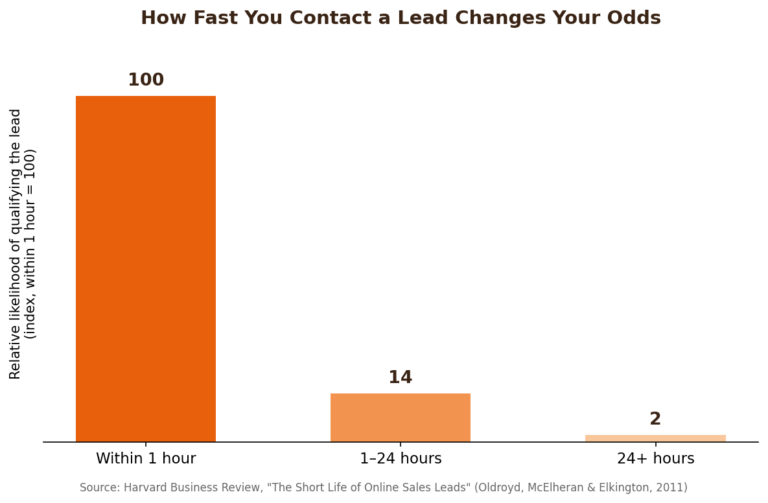
In practice, it looks like this:
- Within 1 hour: highest odds of qualifying the lead
- 1 to 24 hours: odds drop sharply, around 7 times lower
- 24+ hours: odds drop further still, around 60 times lower than responding within the hour
Follow-up sequences that don't feel pushy
A confirmation text right after a form submission, a call attempt shortly after, and a few scheduled follow-ups over the next couple of days cover most leads without feeling aggressive. The goal is to stay present without wearing the customer down.
How much should a moving company spend on marketing?
Most moving companies spend somewhere between 5% and 12% of revenue on marketing, with newer or growth-focused companies often on the higher end of that range.
For example, a company aiming to generate around $200,000 in sales should invest between $10,000 and $24,000.
The right number depends less on a fixed formula and more on what you’re tracking. If your cost per booked job stays well below the profit that job brings in, there might be room to invest more.
Frequently Asked Questions - Marketing for movers
1
How do moving companies get clients?
Most moving companies get clients through a mix of local SEO, an optimized Google Business Profile, social media, online reviews, paid ads, and referrals. Word of mouth and repeat business become a bigger source of clients as a company builds its reputation over time.
2
Is SEO or PPC better for moving companies?
Neither works well alone. SEO builds long-term visibility at a lower ongoing cost but takes time, while PPC delivers faster results at a higher cost per lead. Most successful moving companies use both, leaning on ads while their organic presence grows.
3
How do I make my moving company stand out from competitors?
Focus on the things customers use to compare movers: response speed, review volume and quality, a professional website, and clear, specific service pages. Small differences in these areas often matter more than price alone.
4
How important are online reviews for moving companies?
Very. According to BrightLocal's 2026 Local Consumer Review Survey, 97% of consumers read reviews before choosing a local business, and 41% now say they "always" check reviews before making a decision. A steady stream of recent reviews, and thoughtful responses to negative ones, builds more trust than almost any other marketing effort.
5
What marketing channels work best for small moving companies?
For smaller companies with limited budgets, local SEO, Google Business Profile optimization, and referral programs deliver the best return, since they cost little beyond time and consistency. Paid ads can be added once there's enough budget to sustain them.
Join the Compare Movers trusted network and start getting qualified leads
Marketing works best when it’s paired with a steady source of qualified leads, and that’s exactly what Compare Movers gives your moving company.
Instead of spending all your time and budget chasing customers on your own, join our trusted network and let ready-to-book customers come to you.
- Contact our team today to start receiving leads from people actively comparing movers in your area.
Ready to spend your marketing budget wisely?