
If your moving company’s website is not providing you with the leads you need and expect, there are six reasons why:
wrong keywords attract wrong visitors, your form asks for too much information too soon in the process, your website does not instill confidence, your call to action is unclear, your site is too slow, or you are not following-up quickly enough once a lead converts.
Luckily, all of these issues are easily remedied, and none of them should require you to redesign your entire website.
- Let’s go through them one by one, and then we’ll get into how to convert more moving quotes into booked jobs.
Is it a traffic problem or a conversion problem?
Before trying to fix the problem, you need to figure out what is causing it. In lead generation, there are two types of problems and two different solutions.
A traffic problem means not enough of the targeted audience is visiting your website, and when they do, they don’t stay long.
A conversion problem means you have plenty of traffic, but not many people request a quote. In this case, your traffic on Google Analytics is great, but the number of requests is much lower than expected.
Is your lead problem traffic or conversion?
The first step is to identify the weak link in the lead generation chain. Is there not enough traffic reaching your website, or are visitors coming in but not taking the next step?
Take a look at your website analytics and compare your traffic with the number of form submissions and phone calls.
| What you see | What it means | Where to focus |
|---|---|---|
| Low traffic and few leads | Traffic problem | Google Business Profile, local listings, and paid ads |
| Traffic is increasing, but leads stay flat | Conversion problem | CTAs, forms, trust signals, and content quality |
If your traffic is increasing but your leads aren’t, you likely have a conversion problem. People are finding your website, but something is stopping them from calling or requesting a quote. That’s the problem most of this article focuses on.
Don’t send more traffic to a site that isn’t converting
Investing more money in SEO and ads won’t solve a conversion problem. That’s equivalent to putting water in a bucket with a hole in the bottom.
If your website is already getting visitors but those visitors aren’t requesting quotes or calling, increasing traffic will give you more people who don’t convert.
In this situation, what you need to do is fix the underlying issue, which is conversion.

Your keywords are attracting the wrong visitors
Getting more website traffic sounds great, but traffic only matters if it comes from people ready to book their move. For example, a visitor who googles “moving costs” is looking for information, not a service.
Are you attracting people who want information or a mover?
There’s a big difference between someone searching for moving advice and someone actively looking for a company to hire.
Searches such as “movers near me”, “moving company Montreal” or “Montreal long-distance movers” show much stronger buying intent. These people are no longer just researching how to move. They’re looking for a company that can do the job.
That said, if your SEO strategy is heavily focused on blog posts and general moving questions, you may be attracting plenty of visitors without generating many leads. For a moving company, the goal isn’t simply to rank for more keywords. It’s to rank for the searches your potential customers make when they’re ready to hire.
Make sure the page matches what the customer is looking for
Your main service pages should target the searches that are most likely to turn into leads. That includes pages for residential moving, long-distance moving, commercial moving, and the cities or areas you serve.
For example, if someone searches for “condo movers Montreal” and they stumble upon your generic homepage instead of a movers page specifically for condos in Montreal, you’ve lost a lead. The page should always reflect what the user is looking for.
Your quote form is costing you leads
If the form is too short, it will result in unproductive leads for your company. And if the form feels long, complicated, or annoying to fill out, people may give up.
The key is to balance it out. You want to get in touch without asking people to plan their entire move before they’ve even spoken to you.
Keep the first form short
If the form has more than 5-6 fields, you’re asking for too much. At a minimum, you need a name, phone, moving date, origin/destination, and home size.
You can collect additional details later, once someone from your team is speaking with the customer.
Make sure the form works well on a phone
Over 60% of all web traffic comes from mobile devices. As a moving company, this means most people landing on your website are on their phones. If it’s frustrating for you, it’s probably frustrating for potential customers too, and you could be losing leads because of it.
Ask for the basics first, get the details later
The first form should make contacting you feel easy and low-effort. Save questions that require more thought for the follow-up call, when you already have the customer’s contact information.
| Ask upfront | Ask later |
|---|---|
| Name, phone number, and email | Inventory |
| Moving date | Packing and disassembling preferences |
| Origin and destination | Additional services such as storage or packing |
| Home size | Special items such as a piano, spa, art, or safe |

Your website isn’t giving people enough reasons to trust you
Moving is one of those services where customers put their entire households in the hands of strangers. If your website doesn’t earn customers’ trust in the first seconds, they will go elsewhere to find a company that does.
Put your reviews where customers can see them
Don’t make visitors dig through your website to find out what other customers think. Show your Google rating, review count, and customer testimonials, as it highly influences the consumer’s perception of the company.
Make your credentials easy to find
Make sure to prominently display licensing, insurance, received awards, and any work guarantees that you offer. Do not make customers hunt through menus or footers to find them.
Post behind the scenes with before and after photos, testimonials, and team photos
Stock photos are polished, but they aren’t as trustworthy as authentic behind-the-scenes photos of your business. Whenever possible, show your crew in action, trucks, equipment, and completed jobs.
Trust signals worth adding to your homepage and service pages
- Google rating and review count
- Recent and positive customer testimonials
- Satisfaction or price guarantees, if you offer them
- Photos of your team and moving trucks
- Photos of completed moves
- Years in business or number of moves completed
- Business address and/or service area
- Links to your Google Business Profile or other trusted review platforms
Your call to action isn’t doing its job
Having a vague or weak call to action (CTA) is one of the most common conversion killers on any website.
Tell visitors exactly what happens next
A good CTA should make the next step obvious, specific, and easy to take. Instead of simply telling someone to “Contact Us,” tell them what they’ll get by clicking.
| Weak CTA | Stronger CTA |
|---|---|
| Contact us | Get your free quote in 60 seconds |
| Learn more | See your moving options |
| Submit | Request my free estimate |
| Call us | Speak to a mover today |
Put your CTA where people can see it
Your primary CTA should be visible near the top of the page, then appear again at natural intervals as visitors read through your content.
On mobile, a sticky “Get a Quote” or “Call Now” button makes it even easier to take action without visitors having to scroll back up or down.
Make your phone number easy to find and call
Not everyone wants to fill out a form. Some customers would rather speak to someone, especially when they have questions about their move. Keep your phone number easy to find throughout the website and make sure it’s click-to-call on mobile.
Site speed and mobile experience are driving visitors away
You can have the right keywords, a strong offer, and a great CTA, but none of that helps if your website takes too long to load. In fact, nothing drives away potential customers more than a poor first impression.
Make your key pages load quickly
Since Google’s own mobile speed research found that 53% of mobile visitors abandon a page that takes longer than 3 seconds to load, aim for load times under 2-3 seconds on your key landing and service pages. Particularly on mobile, every additional second of load time increases bounce rate.
Build the quote experience around mobile users
Like previously stated, most local search traffic is driven by mobile devices. This is why you should design your quote with mobile users in mind first, and desktops second. A poor mobile experience can be one of the biggest reasons potential customers leave without requesting a quote.

You’re losing leads after they convert
Sometimes the issue is not the website, but you. After someone converts, you must be quick enough to go after the lead without wasting any time.
Respond while the customer is still looking
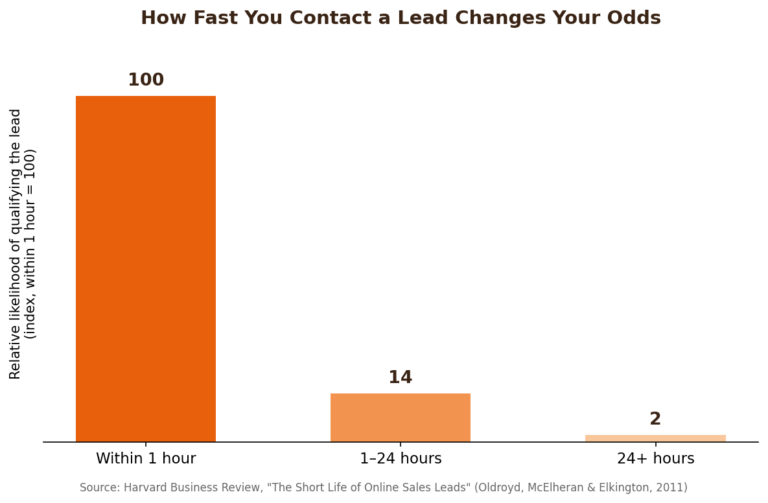
Speed matters enormously in this industry. According to HubSpot’s research on customer responsiveness, 66% of consumers now expect a response within five minutes or less. Movers who respond that quickly are far more likely to book the job than those who call back the next day.
Do not rely on manual tracking and implement a CRM
If you’re manually keeping track of leads in an email or a notebook, it’s entirely possible that some of them will slip through the cracks. With a proper CRM, you ensure that every lead receives a timely follow-up.
Your website can’t close the job by itself
You can improve your SEO, redesign your quote form, add better reviews, strengthen your CTAs, and speed up your website. But none of that matters if new leads sit unanswered.
How to convert more moving quotes into booked jobs?
Once you’ve identified where visitors are dropping off, turning that diagnosis into bookings comes down to a short list of concrete actions.
Here’s the recapitulative version of everything covered above:
- Target the searches that bring customers ready to hire movers
- Keep your quote form down to 5-6 fields
- Make the trust signals visible
- Use actionable CTAs
- Improve site speed and user experience on mobile devices
- Respond to inquiries within minutes, not hours or days
None of these require a full rebuild. Most moving companies see a measurable lift in quote requests just by tightening the form, sharpening the CTA, and speeding up follow-up, the three highest-leverage fixes on this list.
FAQ about moving lead generation
1
Why is my moving company website getting traffic but no leads?
Usually, it’s because your traffic isn’t attracting people ready to hire movers, the quote form is complicated, people don’t trust your company, or CTAs aren't strong enough to move a visitor to act.
2
How do I convert more website visitors into moving quote requests?
You could start by shortening the quote form, adding a focused CTA, and including trust signals to encourage conversions. When implemented together, these three changes tend to have the most significant impact on quote completion rates.
3
What makes a moving company quote form convert better?
The form should be as short as possible, optimized for mobile devices, and enable customers to understand what happens next. Only ask for the information that is necessary for you to request and discuss a quote.
4
How fast should I respond to a new moving lead?
In most cases, you should contact a lead as soon as you receive their request for a quote. In the moving industry, speed makes a major difference in losing and winning a customer.
5
Can online reviews impact the conversion rate of my moving company’s website?
Yes, they do, and they should be an integral part of your strategy. Most visitors will research your competitors and look at online reviews.
6
Should I fix my website or spend more on ads first?
It depends, but before spending money on ads, it’s best to optimize your website first. Once your website’s conversion rate is optimal, you’ll be able to get more value out of every ad.
7
What should I change on my website to improve my chances of securing a lead faster?
If you only have one change that you could make on your page right now, shortening the quote form is the best place to start. By shortening it to 6 fields, you’ll remove the most common barrier to requesting a quote.
Are you looking to generate more moving leads?
Fixing your website is the first step, but even the best-converting site can only work with the traffic it gets.
If you’re ready to grow beyond what your own site brings in, Compare Movers connects moving companies across Canada with customers who are actively comparing quotes and ready to book.
- Fill out our form to talk with us and discover our rates and services.
Become a Compare Movers partner today and start receiving qualified moving leads.